Self-Leadership: Models, Skills, and Positive Leadership Strategies
- Our Subject Matter Experts
- March 27, 2026
- 5:52 pm
- No Comments
“Mastering others is strength. Mastering yourself is true power.” – Lao Tzu.
An ever-evolving and autonomous world calls for self-leadership, which is summed up in this timeless quote: putting oneself first before guiding others. Unlike traditional leadership, which focuses on influencing teams or organisations, self-leadership is about internal mastery: taking responsibility for your thoughts, emotions, and actions to achieve personal and professional goals. Remaining calm, collected, and optimistic in the face of adversity is what it means to have resilience.
Manz (1983) says that to be a good leader at work, you need to be able to motivate and guide yourself so that you can be self-directed and self-motivated. You need to know what you’re doing and be able to control it in order to be self-reliant. To be self-reliant, you need to be able to control your own wants and beliefs and make sure that what you do is in line with them. And the most important thing is to be in charge of your own life.
Self-leadership is a skill that is becoming more important in the 21st century due to the fact that the world is constantly shifting and moving at a rapid pace. Despite the fact that more people are working from home or in a hybrid setup, it is essential for employees and leaders equally to demonstrate responsibility, effective time management, and the ability to maintain productivity even when no one is watching them. Having the ability to take charge of one’s own life has never been more important. The traits of independence, responsibility, and continuous growth are all characteristics of successful professionals in today’s businesses, and they encourage all three of these traits.
The importance of positive self-leadership extends beyond personal productivity. It helps people become more emotionally intelligent, better at solving problems, and more resilient when things go wrong. Houghton and Neck’s (2002) research shows that people with strong self-leadership skills are more flexible, happier at work, and do better overall. People can turn problems into chances to grow by making sure that what they do every day is in line with their long-term goals, building good habits, and controlling what they say to themselves.
The benefits of mastering self-leadership are profound. It improves productivity by fostering discipline, strengthens resilience through self-awareness, enhances decision-making by clarifying priorities, and promotes both personal fulfilment and professional success. If you want to be a good leader, you need to be able to lead yourself well, whether you own a business, manage a team, or work on your own.
This blog will explore the concept of self-leadership in depth from the most recognised self-leadership models and positive self-leadership strategies to the core self-leadership skills every professional should master. We’ll also talk about how self-leadership training can help people reach their full potential and motivate their teams and organisations to make positive changes.
The Foundations of Self-Leadership
The roots of self-leadership can be traced back to timeless ideas about human freedom, responsibility, and purpose. Modern psychology has improved the ideas behind it, but the core idea is still very philosophical: we may not be able to control what happens to us, but we can always control how we react.
Historical Context
The foundation of self-leadership is beautifully illustrated in Viktor Frankl’s seminal work “Man’s Search for Meaning.” Frankl, a psychiatrist and Holocaust survivor, said that people always had the choice of how to feel and respond to pain, even in the worst situations. His philosophy that meaning and purpose arise from how we interpret and respond to our circumstances forms a cornerstone of self-leadership.
Frankl’s insight reminds us that leadership begins within. While we cannot dictate external events, we can manage our internal state our mindset, reactions, and choices. This perspective is critical in the modern context, where unpredictability is constant. You have the power to choose how to handle changes at work, issues in your personal life, or the unknown in the world. This is what positive self-leadership is all about. It moves the focus from blaming to taking responsibility and from reacting to thinking about what happened. This gives people the power to act with purpose and strength.
Core Theories of Self-Leadership
Modern self-leadership frameworks are based on psychological theories that explain how people control their thoughts, actions, and motivations. These three main frameworks stand out:
1. Self-Control Theory
At its heart, self-leadership is about self-control the ability to regulate impulses, emotions, and behaviours in pursuit of long-term goals. Self-Control Theory emphasises the importance of delayed gratification and discipline. It implies that success hinges not solely on talent or intelligence, but also on the ability to manage distractions, resist immediate temptations, and uphold consistency. Self-leadership skills are mainly focused on behaviour in this theory, and self-discipline is seen as a link between intention and action.
2. Social Cognitive Theory (Albert Bandura)
Albert Bandura’s Social Cognitive Theory is another strong base.. It stresses the three-way interaction between personal factors (thoughts and beliefs), actions, and the setting. Bandura thought of the idea of self-efficacy, which means that you can change things if you work hard. This means that how we think affects what we do and how well we do it when we are in charge of ourselves. A person’s proactivity, resilience, and ability to effect positive change are all enhanced when they have faith in their own ability to make a difference.
3. Self-Determination Theory (Deci & Ryan)
Developed by Edward Deci and Richard Ryan, Self-Determination Theory (SDT) explains the role of intrinsic motivation doing something because it is inherently fulfilling rather than externally rewarded. SDT identifies three universal psychological needs: autonomy, competence, and relatedness. Self-leadership training that supports these aspects helps people stay motivated, focused, and in line with their values. People are more committed to their goals when they feel like they have the power to make decisions, gain mastery, and connect with others in a meaningful way.
These theories, taken together, provide the scientific and philosophical basis for self-leadership, which is the way that discipline, belief, and motivation work together to make people reach their full potential.
The Pillars of Self-Leadership
Building upon these theories, self-leadership can be understood through three essential pillars that enable individuals to lead themselves effectively:
1. Self-Awareness and Self-Management
The first step in self-leadership is knowing oneself. Being self-aware means knowing how you feel, what you value, what you’re good at, and what you’re bad at. It allows individuals to make sensible choices rather than being driven by impulses or external pressures. Complementing this is self-management the ability to regulate emotions, maintain focus, and act in alignment with one’s goals. Together, they form the emotional intelligence foundation of positive self-leadership, enabling clarity under stress and composure in uncertainty.
2. Entrepreneurship (or Opportunity Seeking)
True self-leaders think and act like entrepreneurs. They proactively seek opportunities, challenge assumptions, and embrace calculated risks. This pillar of self-leadership encourages innovation and adaptability essential traits in fast-evolving workplaces. Self-leaders turn problems into creative solutions by being curious and strong. They take charge and show initiative in every role.
3. Goal Achievement
The third pillar centres on purposeful action setting and pursuing meaningful goals aligned with one’s values. Effective self-leadership involves creating clear visions, breaking them into actionable steps, and staying consistent even when your motivation changes. Goal-setting not only drives focus but also reinforces accountability, ensuring that actions reflect personal and professional aspirations.
In essence, the foundations of self-leadership combine the wisdom of Viktor Frankl’s existential freedom with the rigour of modern psychology. It is both an inner journey and an outer discipline where self-awareness meets self-determination, and reflection leads to purposeful action. By mastering these foundations, individuals cultivate the mindset and behaviours needed for lifelong growth, adaptability, and success.
Exploring Key Self-Leadership Models
There have been many different models and frameworks for self-leadership over the years.ch one gives us a new way to think about how people can change the way they think, feel, and act to get the best resThese models are useful for encouraging good self-leadership, from Manz and Sims’ groundbreaking work to the use of positive psychology in modern frameworks. They talk about some of the most well-known and important self-leadership models that still affect personal growth and leadership development today.
Manz & Sims’ Self-Leadership Model
Developed in the 1980s by Charles C. Manz and Henry P. Sims Jr., this model is considered the cornerstone of modern self-leadership theory. “A holistic self-influence framework that involves guiding oneself towards the execution of intrinsically motivating tasks while also regulating oneself to complete necessary yet non-intrinsically motivating work,” was how they described self-leadership. As stated by Manz and Sims in 1980.
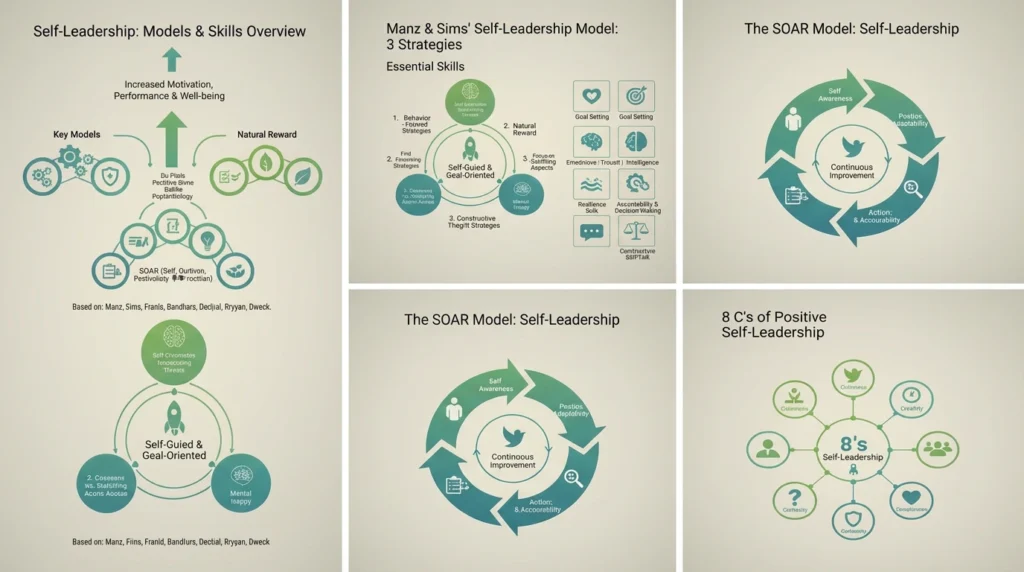
Their model focuses on three interconnected categories of strategies: Behaviour-Focused Strategies, Natural Reward Strategies, and Constructive Thought Strategies. Together, these enable individuals to consciously influence their own behaviour and mindset toward effective goal achievement.
1. Behaviour-Focused Strategies
These strategies emphasise self-regulation and accountability. They include:
- Self-Observation: Keeping an eye on your behaviour to find out what you do well, what you need to work on, and what patterns affect your performance.
- Goal Setting: Establishing specific, measurable, and attainable goals to guide action.
- Self-Rewards: Reinforcing positive behaviour by rewarding oneself upon achieving milestones.
- Self-Correcting Feedback: Evaluating performance and making necessary adjustments for improvement.
- Cue Modification: Structuring one’s environment to remove distractions and promote productivity. Strategies that focus on behaviour are especially helpful for building self-discipline and motivation for tasks that are boring or routine.
2. Natural Reward Strategies
These require you to find satisfaction in the task itself rather than in outside rewards. People can feel more engaged and fulfilled at work by focusing on the fun parts of the job. For example, a teacher might enjoy the process of planning lessons more than the end result. This approach is very similar to Self-Determination Theory, which says that intrinsic motivation is what keeps people performing well over time.
3. Constructive Thought Strategies
This dimension of self-leadership focuses on managing one’s internal dialogue and mental imagery. It encourages people to question their irrational beliefs, replace negative thoughts with positive ones, and picture themselves succeeding. Practices like positive self-talk and mental rehearsal help build confidence, resilience, and clarity essential traits of positive self-leadership.
Manz and Sims’ model lays out a clear path from self-awareness to self-regulation and intrinsic motivation. This makes it a timeless basis for leadership development and self-leadership training programs all over the world.
Du Plessis’ Positive Self-Leadership Capability Model
As leadership theory evolved, researchers began integrating principles of positive psychology into self-leadership frameworks. One of these new ideas is Du Plessis’ Positive Self-Leadership Capability Model, which is based on the strengths-based approach that Martin Seligman and his team came up with.
This model emphasises the use of one’s signature strengths, character traits, abilities, and interests as tools for self-motivation and resilience. Rather than focusing solely on correcting weaknesses, Du Plessis encourages individuals to identify and leverage what they naturally excel at. This not only makes you feel better about yourself, but it also gives you intrinsic motivation, which fits well with the idea of positive self-leadership.
Key components of this model include:
- Knowing your strengths: Being aware of your own skills and talents that help you succeed.
- Authentic Self-Expression: Aligning actions and goals with one’s true values and passions.
- Self-Inspiration: Using internal strengths as motivational drivers instead of relying on external incentives.
- Strengths-Based Growth: Getting better at what you already know how to do to reach mastery and long-term happiness.
This model transforms self-leadership into an empowering and optimistic practice, encouraging individuals to flourish through self-acceptance and purpose-driven action. It is very similar to the idea of positive self-leadership, which says that to be successful, you need to be happy, believe in yourself, and get along with others.
The SOAR Model (Self, Outlook, Actions, Reflection)
People can always use the SOAR Model to help them grow and get better. It works like a cycle. It breaks self-leadership down into four main steps:
- Self: Understanding who you are your motivations, strengths, and behavioural patterns. Self-awareness is the first step to being a good leader.
- Outlook: Shaping a positive and realistic mindset about challenges and opportunities. This step focuses on reframing setbacks as learning experiences and maintaining optimism.
- Actions: Translating thoughts into consistent, goal-oriented behaviours. As you carry out plans that are in line with your vision, discipline and accountability come into play.
- Reflection: Evaluating progress, identifying lessons learned, and recalibrating goals as necessary. Reflection ensures that growth is intentional and sustainable.
The SOAR framework integrates key elements of other self-leadership models self-awareness, mindset, behaviour, and adaptability but presents them in a continuous improvement loop. It reinforces the idea that self-leadership is not a one-time skill but a lifelong practice of learning and renewal.
The 8 C’s of Self-Leadership
The 8 C’s of Self-Leadership model provides a holistic view of the emotional and cognitive qualities that define effective self-leaders. Rooted in leadership psychology and mindfulness, this model emphasises internal balance and authenticity. The eight core traits are:
- Confidence: Believing in one’s abilities and maintaining self-assurance even in uncertainty.
- Calmness: Managing emotions under pressure and responding thoughtfully rather than reactively.
- Clarity: Having a clear sense of purpose, values, and direction.
- Curiosity: Maintaining a learner’s mindset open to new ideas and perspectives.
- Compassion: Showing empathy toward oneself and others; fostering trust and kindness.
- Courage: Courage means doing things that are important to you, even when you’re scared or people don’t want you to.
- Creativity: Creativity means thinking of new ways to solve problems and come up with new ideas.
- Connectedness: Cultivating meaningful relationships and a sense of belonging that supports growth.
The ability to lead oneself effectively exemplifies the emotional intelligence and mental attributes that are necessary to turn theoretical understanding into genuine leadership. They help people lead with purpose and optimism by connecting self-awareness with effective action.
Bringing It All Together
These self-leadership models all have something to teach people about how to motivate themselves to achieve their goals. Manz & Sims’ model lays the foundation through behavioural and cognitive regulation; Du Plessis’ approach adds the dimension of positive psychology and strength-based growth; the SOAR model provides a practical cycle for ongoing self-improvement; and the 8 C’s highlight the emotional and interpersonal essence of positive self-leadership.
Taken as a whole, they lay out a thorough plan for becoming an expert self-leader, one that starts with being aware, progresses through deliberate action, and finishes with ongoing reflection and rejuvenation. Using these models in self-leadership training and in everyday life can help individuals become more resilient, perform better, and lead with impact and authenticity.
Read More – How Leadership Development Companies Transform Businesses
The Transformative Power of Positive Self-Leadership
Self-leadership isn’t just about making progress in life or getting more done; it’s also about changing who you are on the inside.When people stop looking for approval or control from others and start leading themselves in a positive way, they can start to lead from a place of self-awareness, resilience, and purpose. This shift changes how they think, act, and connect with the world around them. Positive self-leadership is powerful because it can change people’s perspectives, improve their health, and have a domino effect that benefits businesses and their employees.
Mindset Shift: From Victimhood to Personal Power
At the heart of positive self-leadership is a profound mindset shift from seeing oneself as a victim of circumstances to recognising one’s ability to shape outcomes through choice and action. Many people unconsciously adopt a victim mentality, believing that success or failure depends on luck, external forces, or the behaviour of others. This mindset often leads to passivity, frustration, and self-doubt.
Self-leadership breaks this cycle by promoting personal accountability and empowerment. It teaches people to focus on what they can control their attitudes, decisions, and responses. Proactive people focus on their network of influence rather than their circle of concern, as Stephen Covey (1989) famously observed in The 7 Habits of Highly Effective People. This idea is in line with the core of self-leadership, which is accepting responsibility for one’s own development and responses rather than waiting for outside change to occur.
People who get training in self-leadership learn how to see problems as chances to grow, which turns weakness into strength. To do well in high-pressure situations, you need to learn how to be independent and have the confidence that comes with being in charge.
Impact on Well-being: Harnessing Positive Self-Talk and Constructive Thinking
Positive self-leadership directly influences emotional and psychological well-being. The way individuals speak to themselves their self-talk profoundly impacts motivation, stress levels, and overall performance. In many cases, healthy self-talk can help distinguish between resilience and burnout.
By practising constructive thought strategies, such as those introduced by Manz and Sims, individuals learn to challenge irrational beliefs and replace self-defeating thoughts with empowering affirmations. Anxiety, low self-esteem, and panic attacks are all alleviated by this change. Studies in cognitive-behavioural psychology show that positive self-talk not only improves emotional regulation but also strengthens problem-solving and decision-making abilities.
People get more out of their jobs when they concentrate on the intrinsic rewards and when their actions are in line with their purpose. This intrinsic motivation serves as a buffer against stress and burnout, making positive self-leadership a sustainable approach to long-term well-being. Building mental resilience is the first step toward long-term success and happiness. This resilience is made possible through the ability to constructively direct one’s thoughts.
Fostering a Growth Mindset
The cultivation of a growth mindset, a notion popularised by Carol Dweck, is another essential component of positive self-leadership.In contrast to the rigid mindset that holds that intelligence and abilities are unalterable and static, Ip (2006) asserts that these attributes can be improved via practice, education, and dedication.
Being able to lead oneself effectively fosters a growth mindset since it promotes self-reflection, constructive criticism, and the pursuit of ever-greater success. Challenges, for effective self-leaders, are opportunities for development, not roadblocks. They strive for higher goals, but they’re not afraid of results and take feedback positively.
Skills necessary in today’s innovation-driven, fast-paced workplaces intrinsic motivation, creativity, and problem-solving abilities are fostered by this mindset. Success in life and work can be yours when you adopt a growth mindset and practice positive self-leadership.
The Ripple Effect in the Workplace
The influence of positive self-leadership extends far beyond individual performance it transforms organisational culture. Self-led individuals model accountability, optimism, and self-discipline, inspiring others to adopt similar behaviours. Their presence naturally enhances team morale and cohesion because they bring solutions instead of complaints, collaboration instead of competition.
When employees take responsibility for their actions and lead with self-awareness, managers spend less time enforcing rules and more time fostering innovation and growth. Every member of the team feels capable of making a meaningful contribution because of the trusting and engaging culture that is fostered by this autonomy.
Moreover, leaders who embody self-leadership inspire authenticity and psychological safety within their teams. Their calmness, clarity, and compassion key traits among the 8 C’s of Self-Leadership encourage open communication and collective problem-solving. Through time, this establishes a work environment that fosters a sense of worth, inspiration, and unity among employees.
A flourishing organisational culture based on empowerment, resilience, and shared success is nurtured by positive self-leadership, which has far-reaching consequences for individual well-being, group performance, and resilience.
Start Your Self-Leadership Journey Today
Take charge of your mindset, strengthen your habits, and align your goals with your core values. Explore BYLD's self-leadership programs—designed to help individuals and organizations reach their maximum potential and lead with conviction, clarity, and impact.
Contact UsEssential Self-Leadership Skills to Cultivate
Developing self-leadership skills is the foundation for personal and professional excellence. With these abilities, one can lead with conviction, make decisions with agency, and face adversity with fortitude and direction. Self-leadership is meant to teach you skills that will make you more motivated, self-aware, and emotionally strong. Additionally, they can demonstrate the effects of your actions on those around you. You should learn these six skills if you want to grow and become a good leader yourself.
Goal Setting & Planning
A clear goal and a well-thought-out plan are the first steps to every great success. The core of self-leadership goal setting is turning dreams into plans that can be put into action. Goals should be SMART, which stands for Specific, Measurable, Time-bound, Achievable, and Relevant. This helps people who are self-leaders make sure that they can reach their goals.
Breaking down large aspirations into smaller, manageable milestones helps maintain focus and momentum. For instance, a professional aiming to become a certified coach can set weekly study targets, schedule practice sessions, and track progress. This organised method not only makes you feel more confident, but it also makes you feel less overwhelmed.
Planning, on the other hand, transforms intention into strategy. Self-leadership involves anticipating obstacles, creating backup plans, and regularly reviewing progress. When people connect their long-term goals to their own values and sense of purpose, they become intrinsically motivated, and the journey is just as rewarding as the end goal.
Self-Motivation & Discipline
Motivation is the engine of self-leadership but it’s discipline that keeps the engine running when the initial excitement fades. Self-motivation stems from a deep sense of purpose and internal drive. Unlike external rewards, intrinsic motivation is fueled by the satisfaction of growth, mastery, and meaningful contribution.
Self-leaders cultivate this energy through self-reflection and goal alignment. People connect their daily actions to a bigger mission by asking themselves why a goal is important. This inner clarity generates persistence even when challenges arise.
Discipline complements motivation by building consistency. It’s the ability to act according to one’s commitments rather than emotions. Setting routines, managing distractions, and practising delayed gratification are key habits of disciplined self-leaders. Together, self-motivation and discipline create sustainable performance where productivity stems from purpose, not pressure.
Emotional Regulation & Intelligence
Emotional intelligence (EI) popularised by Daniel Goleman is at the heart of positive self-leadership. Self-awareness, self-regulation, compassion, and communication skills are all part of it. This helps people understand and control their emotions.
Emotional regulation involves recognising emotional triggers and responding thoughtfully rather than reacting impulsively. In stressful situations, emotionally intelligent self-leaders remain composed, maintaining focus and perspective. This ability prevents emotional hijacking when strong emotions override rational thinking and promotes logical, values-based decisions.
Empathy, another key aspect of EI, enhances relationships by allowing leaders to understand others’ perspectives. It builds trust, collaboration, and psychological safety all essential for thriving teams. Self-leaders promote balance in their own lives and harmony between people by controlling their own emotions and being aware of those of others.
In essence, mastering emotional intelligence transforms self-leadership into a human-centred practice one that values connection as much as competence.
Decision-Making & Accountability
Strong self-leaders take full ownership of their choices and outcomes. Choosing a choice isn’t enough; you also need to make sure it fits in with your long-term objectives, principles, and hopes. Good decision-making requires analytical thinking, risk-taking, and the guts to take action when you’re confused.
Accountability complements decision-making by reinforcing integrity and personal responsibility. Instead of blaming external factors or others, self-leaders evaluate what they can learn from each experience. They see mistakes not as failures, but as valuable feedback loops for growth.
This mindset builds credibility and trust both with oneself and with others. In a professional setting, accountable individuals elevate team culture by modelling responsibility and transparency. As a result, they create environments where others feel empowered to take initiative and own their contributions as well.
Resilience & Adaptability
In today’s VUCA world one defined by volatility, uncertainty, complexity, and ambiguity resilience and adaptability are essential self-leadership skills. Being able to bounce back from setbacks is an example of resilience. Being able to adapt to new situations is an example of adaptability.
Resilient self-leaders don’t avoid challenges; they embrace them as opportunities for learning. They maintain optimism and composure even when plans fail, using adversity as a catalyst for reinvention. Adaptable individuals, meanwhile, thrive in dynamic environments because they are flexible, open-minded, and quick to realign their goals when needed.
Together, resilience and adaptability create emotional agility the skill to remain centred and proactive in an ever-changing landscape. This not only makes each person work harder, but it also helps companies create a culture of innovation and hard work.
Constructive Self-Talk & Visualisation
The way we talk to ourselves affects our confidence, focus, and success in general. Constructive self-talk a core element of positive self-leadership involves consciously replacing negative, self-defeating thoughts with empowering affirmations. For example, transforming “I can’t handle this” into “I will figure this out” shifts the brain from fear to problem-solving mode.
Paired with this is visualisation, the practice of mentally rehearsing success before it happens. Athletes, performers, and business leaders alike use visualisation to enhance confidence and performance. By picturing the steps and outcomes vividly, the brain becomes primed to recognise opportunities and act effectively.
Both self-talk and visualisation draw from constructive thought strategies outlined in Manz & Sims’ model. They help individuals stay centred, optimistic, and prepared even in the face of uncertainty. Over time, these practices rewire the subconscious mind for growth, resilience, and achievement.
Implementing Self-Leadership Training in Organisations
The Need for Formal Training
While self-leadership is often viewed as an internal, personal journey, organisations increasingly recognise the value of nurturing it through structured learning interventions. Self-led workers are more flexible, resilient, and proactive in today’s changing business environment qualities that spur creativity and output. Not everyone, though, is born with these skills. Finding behavioural patterns, enhancing emotional intelligence, and learning useful self-management techniques are all facilitated by formal training. By embedding self-leadership practices across all levels, organisations can cultivate a culture where employees take initiative, remain accountable, and consistently align their personal purpose with organisational goals.
Effective Training Methods
To truly internalise self-leadership, experiential and reflective training methods work best. Workshops provide foundational knowledge and hands-on practice in areas like emotional regulation, self-motivation, and goal setting. Programs for coaching and mentoring provide individualised advice to assist people in recognising their blind spots and maintaining long-term behavioural change. Employees can also learn more about their motivation, stress behaviours, and personalities with the help of tools like behavioural assessments (like the Birkman Method). This self-awareness becomes the cornerstone for self-improvement and better collaboration. Organisations can also integrate e-learning modules, peer learning circles, and action-based assignments to ensure continuous application and reinforcement of self-leadership principles.
The Role of Management
For self-leadership training to take root, leadership must lead by example. The atmosphere that either supports or impedes self-leadership is greatly influenced by managers. When leaders demonstrate behaviours such as accountability, transparency, and empathy, employees are more likely to mirror these actions. A culture of trust and autonomy rather than one of micromanagement empowers employees to take ownership of their work. Encouraging open feedback, celebrating initiative, and creating space for experimentation are key strategies managers can employ to strengthen self-leadership across teams.
How BYLD Helps
At BYLD Group, we understand that self-leadership is the foundation of effective leadership and team performance. Our Self Leadership Training Programs are designed to help individuals and companies reach their full capacities. Our programs provide participants with the necessary tools to increase self-awareness, develop accountability, and maintain motivation, drawing from well-respected models such as Ken Blanchard’s Self Leadership framework. Through tailored workshops, coaching interventions, and behavioural assessments, BYLD empowers employees to take control of their personal and professional growth driving engagement, innovation, and organisational success.
Real-World Examples of Self-Leadership
Viktor Frankl: Finding Freedom in Responsibility
The Austrian psychiatrist and Holocaust survivor Viktor Frankl, author of Man’s Search for Meaning (1946), provided one of the first and most influential examples of self-leadership. Despite being imprisoned in concentration camps, Frankl discovered that while external conditions could strip away everything, they could not take away the freedom to choose one’s attitude. His philosophy that we cannot always control what happens to us, but we can control how we respond became a cornerstone for modern self-leadership theory. Frankl’s experience demonstrates that self-leadership begins with self-awareness, perspective, and purpose, especially in the face of adversity.
Nelson Mandela: Leading from Within Before Leading Others
In his life and work, Nelson Mandela exemplifies the qualities of self-leadership: perseverance, tolerance, and strong moral principles. Mandela turned his bitterness into strength by developing emotional regulation, discipline, and empathy during his 27 years in prison. He led himself first managing anger and practising forgiveness before leading a divided nation toward reconciliation. Mandela’s example reinforces that true leadership is self-leadership multiplied, built on the ability to manage emotions, act with integrity, and remain guided by one’s values even in difficult times.
Elon Musk: Vision, Grit, and Continuous Learning
Modern business leaders like Elon Musk demonstrate self-leadership through vision-driven persistence and self-motivation. Musk’s approach to innovation from Tesla to SpaceX showcases the power of goal clarity, risk-taking, and intrinsic motivation (as described in Self-Determination Theory, Deci & Ryan, 1985). His relentless pursuit of long-term goals shows a strong belief in one’s own abilities, which is a key idea in Bandura’s Social Cognitive Theory, even when things get tough (1986). Following Musk’s example of self-leadership can teach people to challenge assumptions, adapt quickly, and maintain motivation in industries known for their high degree of unpredictability.
Brené Brown: Courage and Vulnerability in Leadership
Researcher and author Dr Brené Brown offers a more introspective example of self-leadership through her work on vulnerability, courage, and authenticity (Daring Greatly, 2012). Brown advocates for embracing imperfection and having the courage to show up even when the outcome is uncertain aligning with the Constructive Thought Patterns of Manz & Sims’ Self-Leadership Model (1980s). By modelling self-compassion and accountability, she empowers individuals to lead with emotional honesty, demonstrating that self-leadership is not about control but about conscious, values-driven action.
Everyday Examples: Self-Leadership in the Workplace
Self-leadership is not limited to famous figures; it thrives in everyday professional contexts.
- A project manager who proactively seeks feedback and adjusts their strategy demonstrates self-observation and self-correcting behaviour.
- An employee who identifies learning gaps and enrols in upskilling courses showcases intrinsic motivation and goal orientation.
- A self-aware and emotionally stable teammate is one who keeps their cool when things get heated and prioritises helping others over protecting themselves.
Both the Positive Self-Leadership Capability Model (2020) by Du Plessis and the Be Behaviour-Focused Strategies (1980) by Manz & Sims stress the importance of reflection, adaptability, and strength-based growth.
The Collective Lesson
Whether it’s Frankl’s moral resilience, Mandela’s emotional mastery, Musk’s innovation mindset, or Brown’s authenticity, the message remains clear leadership starts from within. Being a self-leader is more about owning up to your thoughts, deeds, and development than it is about having a fancy title or position. People have the power to change the world when they take charge of their own lives and lead with honesty and integrity.
Read More – Top 10 Best Leadership Development Programs for your Organisational Growth
Conclusion
To recap, self-leadership is a lifelong talent that calls for belief in one’s own abilities, consistent self-reflection, and the conscious pursuit of objectives. It integrates proven self-leadership models like Manz & Sims’ behavioural natural reward, and constructive thought strategies, along with the positive self-leadership principles that emphasise mindset, resilience, and personal empowerment. Through essential self-leadership skills such as goal-setting, emotional intelligence, self-motivation, and adaptability, individuals gain the ability to direct their thoughts, behaviours and emotions toward meaningful goals, regardless of circumstances.
Enquire Now
Latest News