How to Build Collaborative Leadership Skills and Strategies
- January 12, 2026
The traditional command and control model doesn’t work anymore because workplaces today move so quickly. A multinational company found that almost 70% of workers are happier and more productive when their companies value collaborative decision-making more than management from the top down. This shift reflects a growing realization: success in the modern workplace depends on collaboration, not hierarchy.
Working together as a team, being honest, and taking responsibility are all big parts of collaborative leadership. Unlike authoritative leaders who make unilateral decisions, collaborative leaders bring people together, encouraging input from all levels of the organization. They create spaces where ideas can flow freely, and everyone on the team feels like they can contribute to solving problems and coming up with new ideas.
This approach isn’t just about being “nice” or democratic—it’s about leveraging diverse perspectives to make smarter, faster, and more sustainable decisions. People now think that collaborative leadership skills like active listening, empathy, conflict resolution, and open communication are necessary to keep hybrid and cross-functional teams working well and keep morale high.
The purpose of this guide is to explore the collaborative leadership strategies that modern leaders can use to build trust, strengthen teamwork, and align collective efforts toward organizational goals. You’ll learn about how collaboration can change the way leaders do their jobs, from practical tools to changes in how people think. Finally, we’ll examine the tangible collaborative leadership benefits—from enhanced innovation to improved employee engagement—that make this approach indispensable for future-ready organizations.
What is collaborative leadership?
In the modern workplace, leadership is no longer about giving orders—it’s about guiding, inspiring, and facilitating. The shift from being a “boss” to a “facilitator” defines the essence of collaborative leadership. Cooperative leaders, in contrast to their autocratic counterparts, should listen to their employees before taking action. They try their best to give their team an inspiring ground to talk and take criticism as criticism.
At its core, collaborative leadership is trust-based, openness-based, and respect-based. For everyone to respectfully listen to each other’s ideas, the leader should encourage group decision-making, as this model shows. Inclusivity not only increases creativity but also makes team cohesion and accountability strong. Transparency in communication helps in building trust—team members feel valued, informed, and motivated to contribute their best.
The “why” behind this shift lies in the complexity of modern business challenges. Organizations today face interconnected, cross-functional problems that no single leader can solve alone. In such types of environments, collaborative leadership strategies facilitate access to collective intelligence and enable teams to co-create solutions that are both innovative and practical. It connects silos, knowledge sharing, and increases active response to change.
Collaborative leadership is a crucial competency for professionals to develop, and among these are emotional intelligence, empathy, adaptability, and the capacity to lead productively. In order to maintain an atmosphere of openness and mutual growth, leaders can have productive conversations about how to handle conflicts.
The collaborative leadership benefits are profound—it drives innovation, enhances employee engagement, and strengthens organizational resilience. Whether it’s through command and control or teamwork, effective leaders bring out the best in their teams and make decisions that can keep up with the fast-paced business world of today.
Read More – What is Team Collaboration and Why It is Important
Collaborative Leadership Skills
Successful collaborative leadership depends on a unique combination of interpersonal and strategic abilities that enable leaders to unite teams, resolve conflicts, and inspire innovation. Leaders who develop collaborative leadership skills are better able to guide their teams toward common objectives in an environment that values honesty, openness, and responsibility. These are essential skills that define an effective collaborative leader.
1. Active Listening
Active listening is one of the most vital collaborative leadership skills. You should not only pay attention to what other people say, but also try to understand and respect their points of view. Leaders pay close attention and try to understand instead of reacting. This practice encourages everyone on the team to speak up, which leads to more creativity and openness. By making employees feel heard, leaders strengthen engagement and build a culture where ideas can flourish.
2. Effective Communication
Clear, honest, and open communication is the foundation of collaborative leadership. Leaders must be able to communicate well both in person and online in order to keep everyone on the same page and connected in this age of remote and hybrid work. Clear communication cuts down on misunderstandings, makes sure that everyone is responsible, and builds trust between teams. Effective communicators make everyone feel like they belong and have a purpose, whether it’s through team meetings, project management tools, or virtual collaboration platforms.
3. Empowerment and Delegation
Empowerment is central to collaborative leadership strategies. Leaders who are collaborative don’t micromanage. Instead, they give power to others, letting workers make their own decisions and do their own work. Based on trust, this method raises morale and improves accountability, and encourages new ideas. Empowered team members are more engaged, accountable, and likely to contribute creative solutions that advance organizational goals.
4. Empathy and Emotional Intelligence
Emotional intelligence and empathy are important skills for collaborative leadership that make people feel safe. When leaders understand and manage their emotions—and recognize those of others—they build trust and reduce workplace tension. Empathetic leaders can sense when their teams need support or motivation, creating a positive environment that enhances collaboration and productivity.
5. Conflict Resolution
People who work together will always have different ideas. However, effective collaborative leadership turns these moments into opportunities for growth. Skilled leaders mediate conflicts constructively by encouraging open dialogue and focusing on solutions rather than blame. This way of doing things turns disagreements into chances to learn, builds stronger team relationships, and encourages new ideas.
6. Facilitation Skills
A crucial part of collaborative leadership is the ability to facilitate discussions productively. Collaborative leaders steer discussions, guarantee the inclusion of all voices, and assist the team in making well-informed decisions. Strong facilitation keeps meetings focused and inclusive, balancing differing opinions to find common ground.
Developing these collaborative leadership skills equips leaders to manage complex team dynamics with empathy, clarity, and confidence. The collaborative leadership benefits are significant—greater innovation, stronger team engagement, and improved problem-solving. When leaders master these skills, they create a culture of mutual respect and shared success, positioning their teams and organizations for long-term growth and resilience.
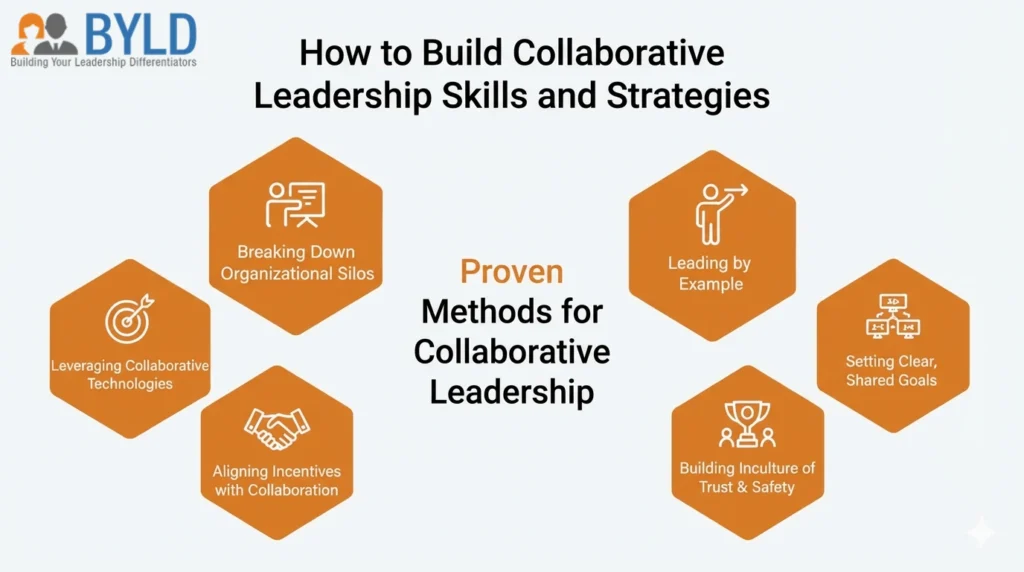
Proven Methods for Collaborative Leadership
Implementing collaborative leadership goes beyond philosophy—it requires deliberate, practical actions that bring teams together, foster trust, and drive collective success. Companies can break down barriers, improve teamwork, and reach measurable goals by using tried-and-true collaborative leadership strategies.
1. Breaking Down Organizational Silos
One of the key challenges in modern workplaces is the existence of silos—departments or teams that operate in isolation. Effective collaborative leadership strategies focus on promoting cross-functional information sharing and cooperation. Leaders can organize regular interdepartmental meetings, joint projects, and brainstorming sessions to encourage interaction. Project management or collaborative intranets can help teams share resources and ideas more easily. On purpose, leaders push people to talk to each other across boundaries so that everyone can work together to solve problems and come up with new ideas.
2. Building a Culture of Trust and Psychological Safety
Trust is the foundation of any successful collaborative leadership approach. Leaders can make people feel psychologically safe by encouraging open communication, paying attention to concerns, and responding without passing judgment. Celebrating transparent communication, acknowledging mistakes as learning opportunities, and soliciting input from all levels signals to employees that it’s safe to speak up. Teams can share their thoughts, take smart risks, and help each other over time in this space. Such an environment makes working together and being a part of it even stronger.
3. Aligning Incentives with Collaboration
Individual success is often emphasized in traditional reward systems, which can unintentionally make people less likely to work together. A good way to get people to work together is to give them rewards that show you appreciate their efforts. Recognizing group accomplishments, offering team-based bonuses, and incorporating collaborative behaviors into performance reviews reinforce the value of working together. Leaders get their workers to help each other and put the goals of the group ahead of their own personal gain by making sure that rewards and recognition are in line with those goals.
4. Setting Clear, Shared Goals
Clear, mutually agreed-upon objectives are central to effective collaborative leadership. Leaders shouldn’t set goals unilaterally from the top down. Instead, they should work with their teams to come up with ideas and agree on what success means to everyone. Having employees help set goals makes sure that everyone is on the same page, boosts commitment, and gives a clear path for coordinating efforts. The team stays on track with regular check-ins and progress reviews that let them make changes in response to new problems or challenges.
5. Leveraging Collaborative Technologies
Digital tools are very important for collaborative leadership strategies, especially when teams are spread out or a mix of locations. Platforms like Slack, Microsoft Teams, Trello, and Miro make it easy to share documents, talk to each other, and keep track of projects. These technologies improve openness, cut down on misunderstandings, and speed up decision-making by standardizing processes and giving people real-time access to information. Leaders who know how to use these tools well give their teams the power to work together effectively from different places and times.
6. Leading by Example
Setting a good example of the behavior leaders want to see is probably the most important part of any collaborative leadership strategy. Demonstrating openness, active listening, and respect in everyday interactions encourages employees to adopt the same approach. Leaders who participate in team discussions, acknowledge contributions, and share credit foster a culture of collaboration naturally. Leading by example signals that collaboration is not just an expectation but a lived value, reinforcing the principles of collaborative leadership skills in action.
When applied thoughtfully, these strategies produce tangible collaborative leadership benefits. Teams become more innovative, engaged, and resilient, while organizations enjoy improved problem-solving, higher productivity, and stronger employee retention. Leaders make an environment where collective intelligence drives long-term success by breaking down silos, fostering trust, aligning incentives, setting common goals, utilizing technology, and showing others how to work together.
As you can see, collaborative leadership is more than just a style; it is a way of doing business that alters how teams collaborate and accomplish tasks.
The Benefits of Collaborative Leadership
In today’s fast-paced business world, companies that use collaborative leadership have a big advantage over their competitors. At BYLD Experiential Learning, we have observed firsthand how applying collaborative leadership strategies transforms not only team dynamics but also overall organizational performance.
1. Improved Innovation and Creativity
One of the most compelling collaborative leadership benefits is enhanced innovation. Teams come up with more creative and solid solutions when they work in an open space where different points of view are welcomed. Leaders who make it safe for their employees to try new things and ask for feedback help their workers think creatively, question what they think they know, and come up with ideas they wouldn’t have had in a traditional top-down structure. This culture of inclusion leads to constant improvement and new ways of thinking.
2. Increased Employee Engagement and Retention
Collaborative leadership skills such as active listening, empathy, and empowerment contribute directly to employee engagement. People feel like they own the project and have a purpose when they know their contributions are valued and listened to. This boosts morale, makes people happier with their jobs, and lowers turnover. At BYLD Experiential Learning, our clients consistently report that teams guided by collaborative leaders show stronger commitment and loyalty, creating a workforce that is both motivated and stable.
3. Enhanced Agility and Problem-Solving
By breaking down organizational silos and encouraging cross-functional cooperation, collaborative leadership strategies allow teams to respond quickly and effectively to complex challenges. Decisions can be made faster, with input from multiple perspectives, ensuring solutions are both practical and sustainable. In today’s fast-paced business world, where adaptability often determines success, this flexibility is very important.
4. Better Decision-Making
Harnessing collective intelligence leads to more informed and widely supported decisions. Collaborative leaders integrate diverse viewpoints, evaluate options thoroughly, and involve teams in the decision-making process. The result is choices that reflect a holistic understanding of the situation, increasing buy-in and reducing implementation resistance.
5. Stronger and More Resilient Teams
Finally, fostering authentic partnerships strengthens team bonds and resilience. When trust and mutual respect are cultivated through collaborative leadership, teams navigate challenges together, recover from setbacks faster, and sustain high performance under pressure.
In essence, the collaborative leadership benefits extend beyond productivity—they shape a culture of trust, innovation, and shared success. Organizations can leverage collaborative leadership to sustain and expand over the long term by employing appropriate strategies and competencies.
Conclusion
Collaborative leadership is implemented by leaders who emphasize trust, mutual respect, and teamwork. Leaders equipped with essential collaborative leadership skills—including active listening, empathy, and facilitation—can implement effective collaborative leadership strategies that break silos, foster trust, and align teams toward common goals. The collaborative leadership benefits are clear: enhanced innovation, stronger engagement, better decision-making, and resilient teams. We help businesses develop these skills and strategies at BYLD Experiential Learning so that leaders can get the most out of their teams. To use collaborative leadership is no longer a choice; it is a must for the future of business.

Latest News