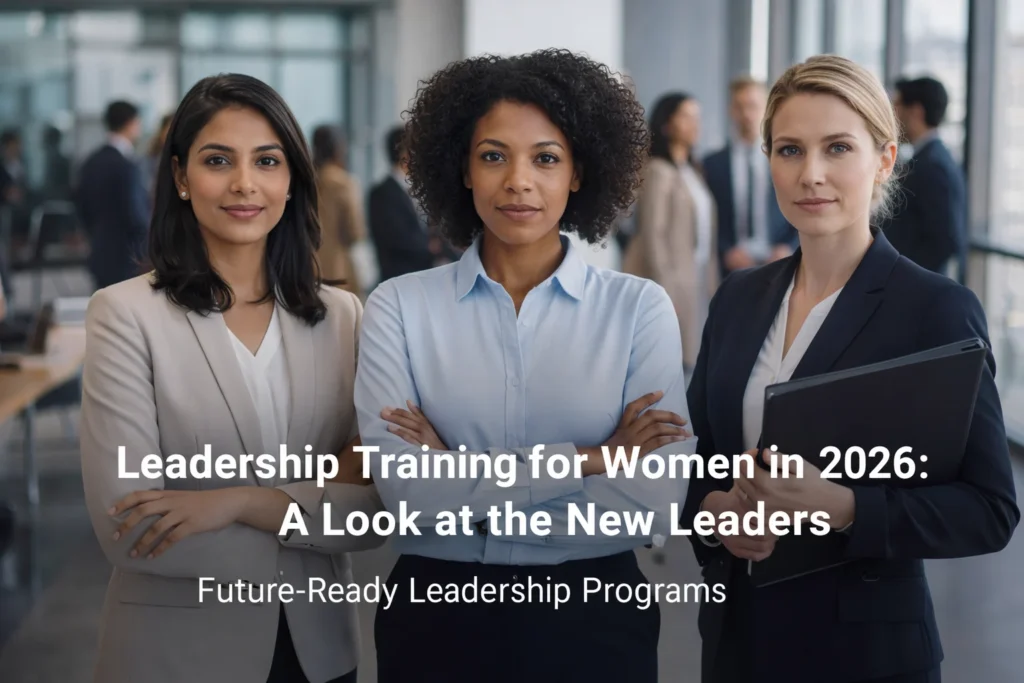
Leadership Training for Women in 2026: A Look at the New Leaders
- Our Subject Matter Experts
- March 17, 2026
- 9:58 am
- No Comments
Article Content
Introduction
The debate on whether women should be leaders or not is no longer a debate but an evidence of the fact that it is indeed so. The question now facing organizations is, are they doing more than enough to develop the women leaders already in organization?
The future 2026 business environment is characterized by a break-neck pace-of-change – the disruptive power of technology, changing workforce demands, geopolitical dynamics and the ongoing re-alignment of organizational priorities. Leadership ability is not a mere competitive advantage in this environment it is a business necessity. And as studies have continuously shown, those organizations that invest in women leaders development are better placed to handle the complexity, be innovative and develop cultures that retain talents.
However even with the increased awareness, the distance between the intention and action is still very large. There is still underrepresentation of women in top leadership positions in industries and in most organizations, leadership development in women is not a priority strategy but a peripheral agenda. This blog is a clear-minded examination of the state of affairs, what still needs to be overcome, what the next generation of women leaders should be able to do, and, above all, the changes that need to be done by organizations to bridge the divide.
The Numbers: Where We Stand in 2026
The figures are changing and they make an interesting narrative. By 2026, women currently represent 10.4% of Fortune 500 CEOs, the highest-ever percentage, but still a devastating demonstration of how far they have to go. McKinsey Women in the Workplace 2024 report, published globally, notes that although women constitute approximately 50 percent of entry-level positions in corporate organizations, the percentage decreases to only 28 percent at the senior vice president position and even lower at the C-suite position.
What this informs us is not hard, the pipeline exists. This is the issue with the way the organizations cultivate, develop, and promote the already existing women in the organization. It is no more the good-to-have leadership training, but the placement between potential and position.
Barriers That Still Exist
It would be wrong to appreciate the progress without considering the obstacles that still exist. Although, there has been more awareness regarding gender equity, there are a number of structural and cultural issues that restrict the emergence of women in leadership.
Unconscious Bias in Promotions: It has always been found that women are assessed basing their previous performance whereas men are promoted basing on potential. This is implicit but highly ingrained prejudice where talented women who are equally good in their respective fields get often overlooked in seeking leadership positions without the organizations necessarily being aware of it.
The Confidence Gap vs. The Competence Gap: Women have been accused of lacking confidence, however, the closer reason is that organizations did not create an environment in which women confidence can be nurtured. Most of the time, women score more points in the leadership tests but nevertheless remain reluctant to take the seat at the table. This is not a weakness of mine; it is a weakness of the system.
Absence of Sponsorship: There are numerous mentors in most organizations who provide directions and counseling to women. They just lack sponsors seniors who champion them in serious discussions, offer them challenging assignments, and nominate them when opportunities are available. Mentorship guides. Sponsorship opens doors. It is the difference between the two that paralyzes the leadership path of most women.
These barriers are not only the right thing to counter, but also have a direct influence on the performance, retention, and innovation of organizations. The leaders training programs that do not ignore such obstacles and instead actively combat them are the ones that bring about a permanent change.
The Reason Women Leaders are the Need of the Hour
Companies that still fail to embrace women as leaders are not merely failing the diversity tick box test, they are losing quantifiable business value. Women leaders introduce a new array of strengths that are gaining more and more correspondence with what modern organizations require most of all.
Women rank significantly above on important dimensions of the leadership effectiveness, such as the capacity to establish strong relations, establish teamwork, and make teams feel motivated and encouraged. These are not soft skills- these are the abilities that generate interest, lower the turnover rate and the one that maintain performance in the long term.
Another leadership style that comes naturally with women is the style of inclusion. They will be more inclined to explore the views of other people, establish a consensus, and establish psychological safety in their teams. These attributes are directly associated with the business results in an era where the main distinction factor is innovation.
Moreover, emotional intelligence of women, their skills to read situations, learn what can motivate others, and operate in complicated interpersonal relationships, helps them to become outstanding change managers. This is not an extravagant benefit in a business setting where constant change is essential. It is essential leadership skill.
Build the Next Generation of Women Leaders
Organizations that invest in leadership development create stronger teams, better decision making, and a future ready workforce. Explore how structured leadership programs can help develop high potential women leaders in your organization.
The Skills that will make Women Leaders in 2026
In the year 2026, leadership skills will have a wider and dynamic range than ever. The new business environment demands a new dimension of skills, although emotional intelligence is one of the core areas of strength.
Managing Hybrid and Remote Teams: The new workforce is decentralized. Female leaders with the ability to develop trust, manage cohesiveness in the team, and push physical or virtual performance are turning out to be invaluable assets to their organizations. This demands conscious communication policies, online proficiency, and having the capability of maintaining culture outside the office.
Artificial Intelligence and Technology Futurist: AI does not require leaders to become technologists; however, they must know how artificial intelligence, automation, and data-driven decision-making are transforming their industries. Women leaders who actively seek to develop this literacy are better placed to be in front of change and not merely act as a reaction to change.
Leading In the Dark: The post-pandemic business environment has brought about one certainty that nothing can be expected less than disruption is the new reality. Being able to calmly lead, decide on imperfect information and motivate the teams with ambiguous information is a critical leadership skill. Women by their very nature, which makes them more prone to collaborative problem-solving, are especially well-placed to succeed in this environment, as long as they are equipped with the appropriate training and structures to direct these capabilities in the right direction.
Cross-Cultural Communication: With organizations being spread over boundaries and workforce being more diverse, the skill of communicating effectively and in a culturally sensitive manner is one of the leadership qualities. The development of this competency will empower the women leaders to work in global teams, negotiate relationships with stakeholders, and create inclusive work cultures.
Practical Current Effects of Organized Leadership Training
The effectiveness of properly-engineered gender-specific leadership programs among women is not a myth, but rather is quantifiable. Companies that have invested in systematic women leadership growth have always served to record better business performances.
According to McKinsey, companies that have high gender diversity in senior leadership have 25% more chances of recording above-average profitability in comparison with their counterparts. More to the point, they claim increased employee engagement, reduced turnover, and increased indices of innovation.
Based on what has happened in the highest profile FMCG and professional services companies: by taking women through special leadership programs, ones that incorporate competencies training, executive coaching, peer group networks, actual project ownership, their promotion rates shot up more than 18 to 24 months. It is not a mere career victory of people. They result in more powerful teams, enhanced decision making at the helm and future ready organizations.
The message to organizations is simple enough; making investment in the leadership growth of women is not an expense to them, but a strategic benefit with a visible payoff.
What Companies really ought to do differently
The first step is the recognition of a necessity to develop women leadership. Most organizations should tighten their bows at designing programs that really produce results.
Design not Tokenism: Female leadership programs should not be just a series of checkboxes. They ought to be constructed based on actual skill deficiencies revealed during the assessments and not speculation. A universal workshop can hardly shift the needle. Individualized learning pathways -that are based on the position, industry, and level of development of the person- are much better.
Integrate Training and On-the-Job Practice: Leadership development programs that have been most effective involve combining formal training with practice. Allowing women to work on cross-functional projects, exposing them to the senior forums and providing them with the opportunity to practice leadership in real-life business situations will develop them much faster than classroom education.
Measuring the Right Metrics: Organizations should go beyond the numbers of participation. The actual measures of success include, promotion rates of women after the program, retention of high-potential female leaders, performance ratings prior to and after training and increment in the women representation at senior positions within a time span of 2-3 years.
Continuous Leadership Development: A two-day workshop will not develop a leader. Organizations with the best results view the development of women leaders as a continuous investment, which is through coaching, peer learning circles, mentoring programmes and availability of stretch opportunities, which continuously challenge and develop their women leaders.
Conclusion
The organizations that will lead in the next decade are not the ones waiting for gender parity to happen on its own they are the ones actively building the environments, programs, and cultures that make it possible. Women leaders are not a future investment. They are a present-day asset that most organizations are yet to fully develop.
Leadership training for women is not about correcting a deficit. It is about recognizing the strengths that already exist, equipping women with the tools and frameworks they need to lead at their highest level, and ensuring that organizations have the leadership depth required to compete in a complex world.
If your organization is ready to build a leadership pipeline that reflects the full range of talent available to you, structured and customized leadership development programs are the place to start. The gap between where your women leaders are today and where they could be tomorrow is not a matter of capability it is a matter of investment.
Take that step today.
Frequently Asked Questions
Not at all. In fact, the earlier organizations invest in developing women leaders, the stronger the pipeline becomes. Leadership training is valuable at every stage — from first-time managers building foundational skills to senior leaders preparing for C-suite transitions. The content and focus naturally evolve with seniority, but the need for structured development is universal.
Behavioral and skill shifts can begin to show within 3 to 6 months of a well-structured program. However, the most meaningful outcomes increased representation in senior roles, stronger team performance, higher retention typically become visible over an 18 to 36-month window. Leadership development is a long-term investment, and organizations that approach it as such see the most significant returns.
The most effective programs are rooted in real assessment data, combine skill-building with coaching and peer learning, and are supported by organizational commitment not just HR initiatives. Programs that fail tend to be generic, one-time events with no follow-through, no manager involvement, and no accountability for application back on the job.
Both have their place. Women-only cohorts create a safe, focused environment where participants can discuss challenges candidly and build strong peer networks. However, this should complement not replace inclusive leadership development that involves the entire organization. True change happens when both men and women in leadership roles are developed with a shared understanding of what equitable leadership looks like.
The bridge between learning and application is built through manager involvement, peer accountability, and structured follow-up. Organizations that assign post-program action plans, create internal communities of practice, and integrate learning goals into performance conversations see significantly higher application rates than those that treat training as a standalone event.
Enquire Now
Latest News